
Post-COVID, real estate teams around the world are confronting enormous uncertainties around workplace change, building occupancy, new usage patterns, and evolving employee expectations. Following the massive remote work experiment caused by the pandemic, most employees now want the option to work from home at least part of the time. And especially at the high end of the labor market, employees have never had more leverage than today.
Le travail hybride, une option à long terme
Ainsi, de nombreuses entreprises étudient la viabilité d’un « environnement de travail hybride » à long terme. Elles se tournent de plus en plus vers des aménagements flexibles et reconfigurent leurs espaces de travail pour s’adapter aux nouvelles méthodes. Ce faisant, elles ont besoin d’évaluer leurs besoins en différents types d’espaces et déterminer quelles commodités elles devront fournir à l’avenir. Pour prendre des décisions en toute confiance, les organisations ne peuvent plus se fier à des données d’utilisation disparates, incomplètes et déconnectées. Elles ont besoin de données plus granulaires et connectées, d’analyses avancées et de puissants outils de visualisation des données. Pour gérer au mieux un lieu de travail flexible avec une main-d’œuvre dispersée, les entreprises ont besoin de données en temps réel.
Données en temps réel
Think of it this way: running an office becomes more like driving a car. You expect your car’s engine computer to monitor and control all essential functions in real-time. And even to adapt to changing conditions and your own driving patterns. You also want live information on speed, lights, fuel, etc. And you expect to get an alert as soon as anything is malfunctioning or when a risk emerges (low temperatures and risk of slippage, for example). This is precisely the type of live data that FM teams in a flexible workplace require as well so that they can act on information as it happens. Even more importantly, real-time data helps employees smoothly navigate the complexities of a hybrid workplace and have a productive workday.
Dans l’ensemble du secteur, on reconnaît le pouvoir transformateur d’une connectivité et d’une analyse améliorées par les apports de l’IoT
Intérêt et impact des technologies liées à l’IoT
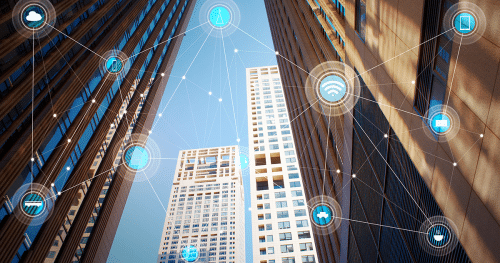
Even before the pandemic, the rise of coworking spaces, the explosion of the Internet of Things (IoT), and growing awareness of the potential of machine learning and artificial intelligence for transforming workflows were already driving speculation about the future of building and workplace change management. These advancements, along with the benefits they bring in terms of flexibility and efficiency, rest on a backbone of connected software tools. This software platform captures Smart Building data and transforms it into actionable information, often through automated processes.
Across the industry, there is a recognition of the transformative power of increased connectivity and analytics from the IoT to manage workplace change. To reflect the profound changes brought about by IoT-related technologies and the shift to hybrid workplace strategies, consulting firm Verdantix in May 2022 launched a new software category: Connected Portfolio Intelligence Platform or CPIP.
Connected Portfolio Intelligence Platform (CPIP) : la nouvelle ère des logiciels IWMS
As Verdantix states in its report Market Insight: The Transformation Of IWMS To Connected Portfolio Intelligence Platforms (CPIP): “Since the 2000s, firms have used integrated workplace management systems (IWMSs) as a central point of integration across assets, space, maintenance, energy, and workplace management processes. Today, IWMS solutions are evolving into a new era, shaped by analytics, the Internet of Things (IoT), and employee-facing functionality, to offer new value to customers.

Verdantix définit les CPIP dans les termes suivants : « plateformes connectées dans le cloud, aidant les entreprises à améliorer les performances des bâtiments via la gestion du portefeuille, l’exploitation opérationnelle et le vécu des employés. Ces plateformes combinent intelligemment les données issues des systèmes des bâtiments et des dispositifs des bâtiments intelligents et de capteurs IoT avec des processus analytiques avancés, des moteurs de gestion des flux de travail et des solutions mobiles. »
Selon le cabinet de conseil, les principaux éléments des CPIP sont les suivants :
- Large suite de modules
- Saisie de données en temps réel à partir des capteurs, des équipements du bâtiment et des systèmes existants.
- Intégration des solutions tierces et des meilleures solutions via des interfaces de programmation d’applications (API).
- Interfaces utilisateur homogènes entre modules et appareils
- Analyses avancées s’étendant sur plusieurs modules
Leveraging an intelligence platform to stay on top of workplace change
La capacité des capteurs et des appareils IoT à apporter des données en temps quasi réel est un atout unique pour les espaces de travail. Associée à de puissants outils d’analyse, elle permet d’obtenir un meilleur aperçu et de créer des flux de travail plus ingénieux. Les domaines d’utilisation principaux sont les suivants :
- Optimisation de l’occupation, de l’utilisation et de l’efficience des espaces
- Monitoring indoor air quality and improving health and vitality
- Indications en temps réel aux utilisateurs
- Confort thermique et efficacité énergétique
- Efficience de la gestion des services des installations
Un lieu de travail peut être un immeuble de bureaux, mais il peut tout aussi bien s’agir de l’étage d’un hôpital, d’un aéroport, d’un entrepôt ou de tout autre type d’installation où le travail est effectué et les services fournis.
Ce billet de blog est un extrait du livre blanc de juin 2022 sur la Gestion transformatrice de l’environnement de travail.