Facility teams live between two worlds: the daily work of keeping buildings running, and the long term planning that keeps assets healthy for years. This release adds a genuinely useful way to report issues without an app or a login, tightens how service level agreements are tracked, and for the first time connects Asset and Maintenance Planning into one coherent workflow.
Report an issue with a scan, no app required
Someone always notices first. The visitor who sees water pooling under the coffee machine. The employee who’s mentioned the stuffy meeting room three times and given up. Until now, none of them had a way to tell you that didn’t involve finding an app, remembering a login, or tracking someone down.
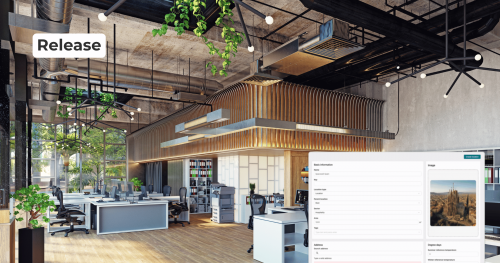
Spacewell Scan changes that. A QR code on a room or an asset is the whole interface. Anyone points a phone camera at it, and a short, guided form opens right there, already knowing exactly which space or asset they’re standing in front of. No app, no account, nothing to install.
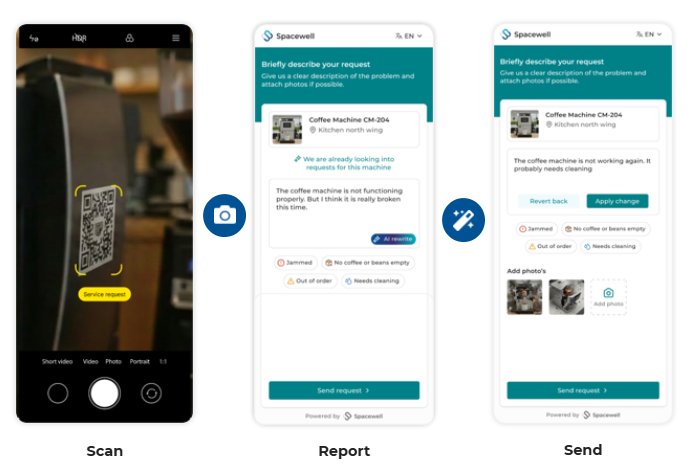
The AI does the part people usually skip. Suggested issues appear before anyone even starts typing, so a tap is often all it takes. If someone does write a few words, AI tidies it into something your service desk can act on immediately, and quietly fills in the problem type and a subject line behind the scenes. If the same issue is already being handled, the reporter sees a short note saying so, instead of filing a fourth ticket for something your team already knows about.
The result is a service request that arrives clear, correctly categorized, and free of noise, from someone who never had to think about any of that. Every space and asset becomes a place where a problem can be reported the moment it’s spotted, not whenever someone finally remembers how.
Sharper deadlines with SLA tracking
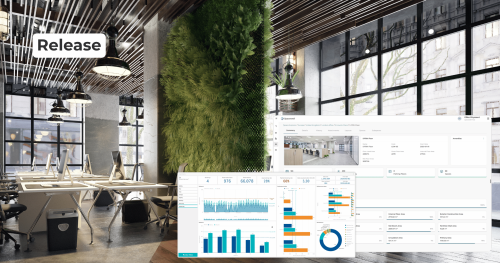
A service level agreement is only useful if someone can see it before it’s broken. This release brings SLAs properly into corrective work orders, so the remaining time to complete a job is visible right on the record, not buried in a report someone checks once a week. The service desk and executor startboards now show it directly, and a portfolio level dashboard gives a live view across everything at once.
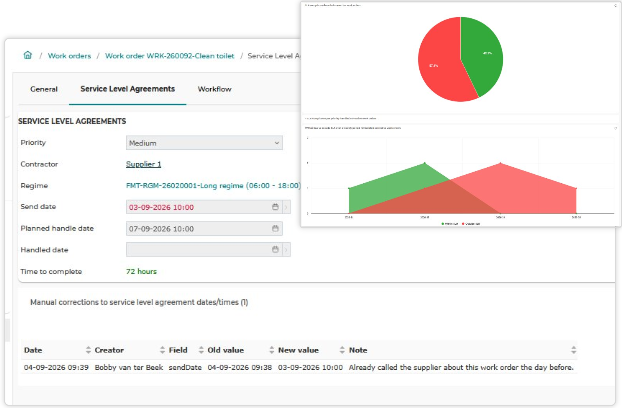
Not every supplier works the same way, so targets shouldn’t either. Deadlines can now be set per supplier and per priority, so a plumbing contractor and an HVAC specialist each get a target that reflects how they actually work, not a one size fits all number that’s wrong for both of them. Leave a planned end date blank and the system calculates it automatically from the applicable SLA, one less thing to configure by hand. Request based SLAs also got a cleaner home, with clearer labeling, a dedicated detail tab, and the option to base schedules on fields beyond priority, such as supplier or building.
The effect is simple: deadlines stop being a number typed in once and forgotten, and start being something the whole team can see, trust, and act on before it’s too late.
Spacewell Asset and Maintenance Planning, finally connected
Facility teams and asset planners have always been solving different problems with the same buildings. One is reacting to what’s broken today, the other is planning for what needs attention over the next ten years. Until now, they’ve mostly done that with separate data, which means separate entry, separate errors, and separate blind spots.
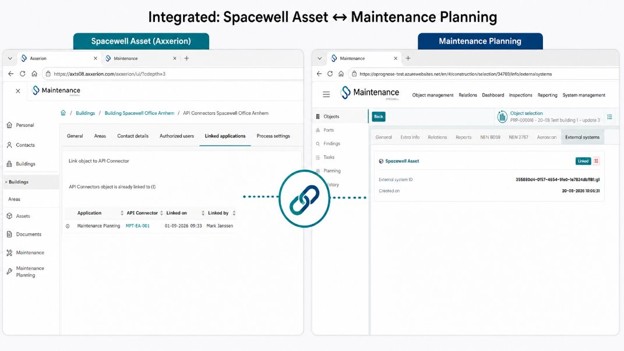
This release connects Spacewell Asset and Maintenance Planning directly, through a bidirectional integration. Buildings, assets, and tasks can now be linked through the API, so a building tracked in Asset and a task planned in Maintenance Planning are talking about the same thing, not two records that happen to look similar. Buildings stay led by Asset, assets can be led by either platform depending on where a team actually works first, and tasks remain led by Maintenance Planning, flowing to Asset for execution and back again once the work is done.
The rest of the release makes that connected world easier to step into. Condition assessments now support the new NEN 2767-2:2025 standard, with an automatic migration wizard for anyone still on the older format. A new inspection app captures findings and photos on site, online or offline, so nothing waits until someone’s back at a desk. And getting data into Maintenance Planning in the first place is considerably less painful, with a standardized Excel round trip and purpose built exports for HOA management, financial reporting, and O-Prognose migration.
What this means for the user
What this release adds up to: problems get reported earlier, by more people, with less effort. Deadlines are visible and shaped around how your suppliers actually perform, not a generic target nobody trusts. And for the first time, the work you do today and the planning you do for the next decade run on the same data, instead of drifting apart in two systems that never quite agreed.
Not a Spacewell customer yet? Fill out the form below and let our team guide you through the first steps toward a smarter, more connected workplace.