
In this blog article, we’ll be looking at how IoT sensor technology, and the data derived from it, can optimize the hybrid workplace experience.
Business objectives of a great workplace experience
A positive employee experience is not a nice-to-have; it’s an essential condition for companies to compete effectively. This is particularly pronounced in knowledge industries, where creativity, innovation, and intellectual engagement are huge drivers of value.
The physical/digital workplace plays an important role in the overall employee experience and productivity. Its objective is to take away barriers to productivity and to create a high-performing, agile environment in which employees can do their best work. Technology is the glue for this.
The importance of technology for successful hybrid working
Smart workplace technologies are virtually essential to making flexible workplace concepts work smoothly. For example, a sensor-based reservation system for workstations is essential in a workplace in which teams are frequently changed, employees regularly switch between different work areas, and the seat-to-employee ratio is low. Also, the closer you get to optimal or peak usage of meeting rooms on busy office days, the more you need digital tools that provide real-time information on actual occupancy.
A responsive workplace, enriched with sensor data
Organizations that implement an Integrated Workplace Management System (IWMS) that integrates with the IoT have a head start over others. By capturing live data from sensors, such a system can give employees visibility into real-time space availability across multiple floors or sites, through a mobile app.
An example is the Spacewell Workplace App that employees can use on their own smartphones or via other user-friendly touchpoints like kiosks and other screens. App functionality makes navigating a flexible workplace much easier. Search tools help users understand which spaces are available, what features exist in each space, what the ambient conditions are, and how to navigate to those spaces. Booking functionality allows users to make sure that they have access to the space in the moment or to plan ahead for their day. The integration with IWMS also makes it possible for users to request services and for service providers to deliver services when they are needed.
From the real estate manager’s perspective, such workplace technologies provide essential information about what spaces employees actually use so that they can optimize the space mix. Perhaps a building’s focus rooms are booked back-to-back all day while large conference rooms sit empty, suggesting that there is a mismatch in the types of spaces being provided and what is needed. Or maybe employees avoid the space because it is too cold, too hot, or too stuffy.
Benefits of leveraging the IoT for a better workplace experience
Enhancing workplace scheduling with usage data in real-time
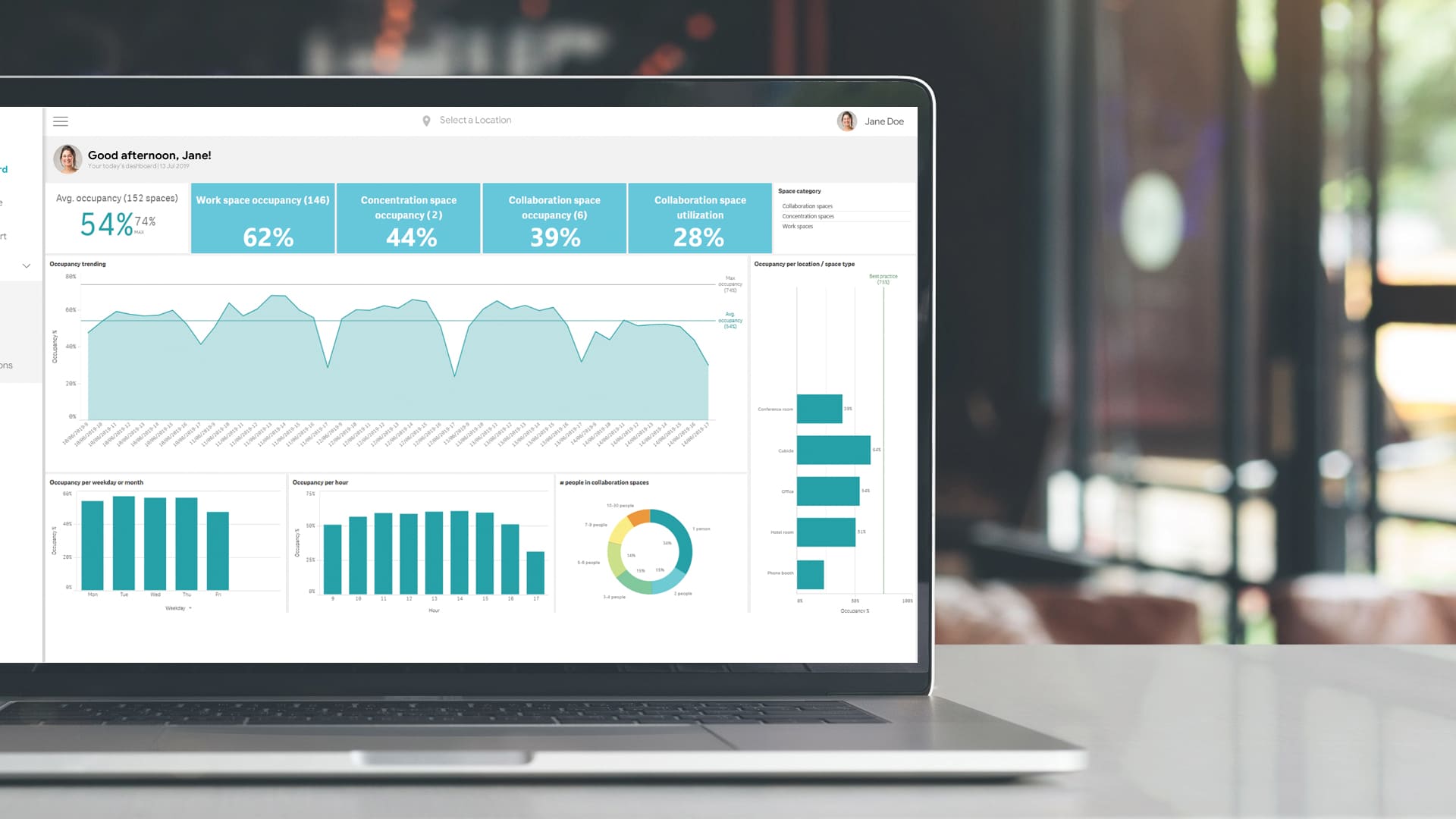
Live sensor data on digital floor plans make the workplace fully transparent for employees. Employees have access to this data in real time on their smartphones and other digital touchpoints. So that they can easily find and book suitable spaces with the right amenities and ambient conditions. Janitorial workers also get visual instructions on mobile devices, showing them where to go and what tasks to perform. Priorities can be quickly updated, based on user requests or sensor triggers. The result: building users are happier and job satisfaction increases.

Leveraging utilization data for long-term planning
Beyond its real-time benefit, space utilization data from sensors also provides essential information for long-term planning. It is more accurate than information from traditional reservation systems and, therefore, more reliable as a basis for getting the office space mix right or determining the ideal employee-to-desk ratio.
3 – Improving employee well-being with sensor data
Many sources of indoor air pollution can affect human health and cognition. Studies show that in offices across the world, poor ventilation, CO2 buildup, and particulates (which carry VOCs) conspire to significantly impair cognitive function. The quality of the indoor air we breathe may also influence our mood and mental health. Comfort and air quality sensors in the workplace can monitor many aspects of environmental quality, from volatile organic compounds (VOCs) to CO2, temperature, humidity, and radon at a localized level.