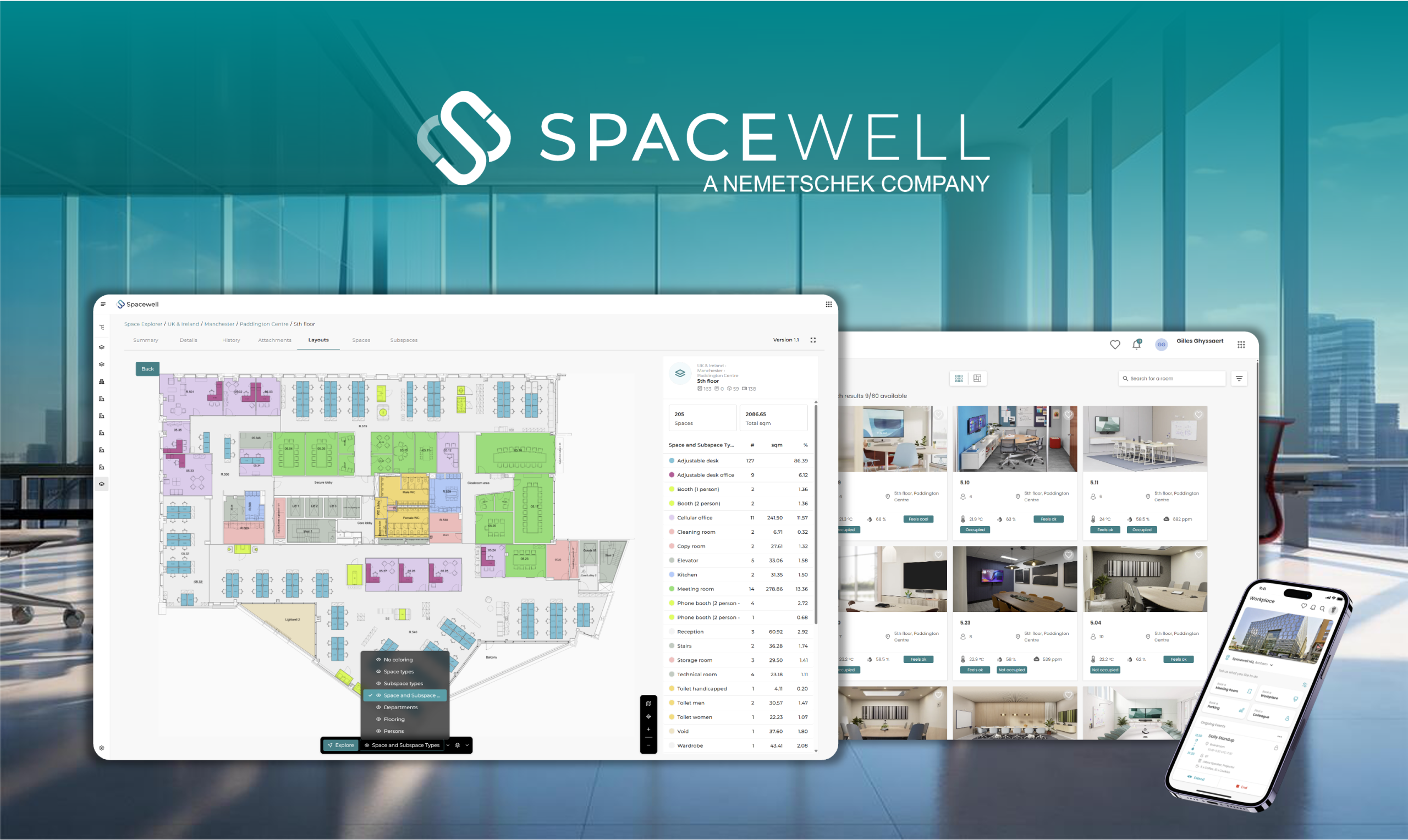
Co-authored by Spacewell and VergeSense.
Enterprises have never generated more data about how their workplace is used, yet space decisions are still made the same way they always were: on headcount projections, desk ratios, and a view formed before anyone tests it. The information that could ground those decisions already exists, but it sits fragmented across IWMS systems, workplace experience platforms, booking tools, badge systems, WiFi, HR systems, recorded as a history of what happened rather than being leveraged as data to inform decisions about what’s next.
But there is a better way. Bring the data together and space planning stops being a slow, expensive study and becomes a decision the business can make in hours, on its own evidence, and revisit whenever the workplace changes.
Space planning is still a guess, and the evidence is untapped
A lease comes up for renewal in nine months. Two floors look underused, but nobody can say by how much, or which teams would feel it if they went. Headcount is projected to grow. Attendance is thin on Mondays and Fridays. Leadership already has a view. So the decision gets made the way these decisions have always been made.
The same pattern plays out on consolidations, refits, and every hybrid policy revision. Not because the teams making these calls lack rigor, but because the evidence that would settle the question is not in front of them when they need it.
That evidence exists. Floor plans and space allocations, room bookings, badge data, WiFi, video conferencing, sensor data, service requests, employee experience signals. It is real, it is specific to trends occurring across your portfolio, but almost none of it reaches the decision. It lives in separate tools, each built to record what happened rather than to forecast what is needed next.
The cost is quiet but real. Floors that don’t match how teams work. Space paid for and left unused. Decisions defended on instinct when finance asks how the number was reached. The industry senses the gap. Demand for faster, evidence-led planning is rising across every customer we work with. So the question worth answering is this: what would it take to plan space around how people genuinely work, using the data you already have?
It’s now possible to forecast what a space will need
How a building is used is now a measurable fact rather than an estimate. Occupancy Intelligence reads genuine use at the building, floor, and individual space level, helping you understand which settings are in demand, which sit idle, and how that shifts week to week.
The second change is forecasting. With Predictive Planning from Vergesense, it’s now possible to understand how a given team will use a layout before anyone moves, surfacing capacity, the effect of a hybrid policy change, and the right mix of space types. The plan stops being a projection of history and becomes a forecast grounded in behavior. At the core sits the Large Spatial Model, VergeSense’s behavioral model of how enterprise workplaces operate, trained on more than 250 million square feet of real workplace data.
All you need to start is a floor plan. Adding the data you already collect sharpens every forecast, and where precision matters most, sensors upgrade an individual building from forecast to ground truth.
“The safe bet has always been to bring in consultants and defer to their experience. But experience isn’t evidence, and that process is too slow for how fast workplaces now change. The blind spot has never been a shortage of opinions. It’s the absence of data to ground them, when that data is already sitting in the systems these teams run every day.” Dan Ryan, CEO and Co-founder, VergeSense
Your building and workplace data is evidence waiting to be used
Which raises the obvious question: where does that data come from?
For most enterprises, the answer is the platform they already run their workplace on. Spacewell holds the system of record: floor plans, space hierarchy, allocations, and portfolio data. It also holds the employee experience layer where people meet space every day, through booking, the mobile app, the AI Assistant, visitor flows, and service requests.
Every one of those interactions is a signal. What gets booked and what gets skipped. How teams move through a floor over a quarter. Where service requests cluster, which is often the earliest sign that a space is not working. Today those signals are used to run your buildings. They can also be used for planning purposes. Occupancy and other IoT data enrich that foundation further. Best of all, for many organizations, this data is already structured, current, and live, meaning you can tap into existing infrastructure without requiring additional funding or time for installation.
Enterprise portfolios with hundreds of buildings run on Spacewell today, and the foundation reaches beyond workplace and occupancy. Spacewell connects workplace, real estate, facility, maintenance, and energy information around the same underlying portfolio and space data. Combined with VergeSense’s predictive planning capabilities, that moves organizations from understanding and running the workplace they have toward forecasting what they need next.
Two principles sit underneath this for both of us. The data stays secure and governed, handled under the privacy standards European enterprises rightly insist on. And the AI is here to make real estate, workplace, and facility teams faster and better informed, not to make their judgment redundant.
“The real cost of guesswork isn’t just another workplace study. It’s the endless time spent in boardrooms debating assumptions without a shared view of the facts. Combining Spacewell’s operational context with VergeSense’s predictive intelligence gives real estate, workplace and finance teams one shared, fact-based language for portfolio decisions. Start with the evidence you already have,and turn it into decisions everyone can understand and act on.” Gilles Ghyssaert, Chief Product Officer, Spacewell
The way this gets done today, and why it fails
For many organizations today, the status quo approach to planning isn’t working. A workplace study runs three to six months and costs anywhere from $250K to $1.5M or more. It arrived already out of date, because the workplace conditions changed during the course of the study. Recommendations are often built on historical ratios and comparable portfolios rather than on the organization’s own data and circumstances. The moment headcount, policy, or attendance shifts, the answer is wrong again and the cycle restarts from zero, usually with a new procurement process attached.
A new way: connect the data to the decision
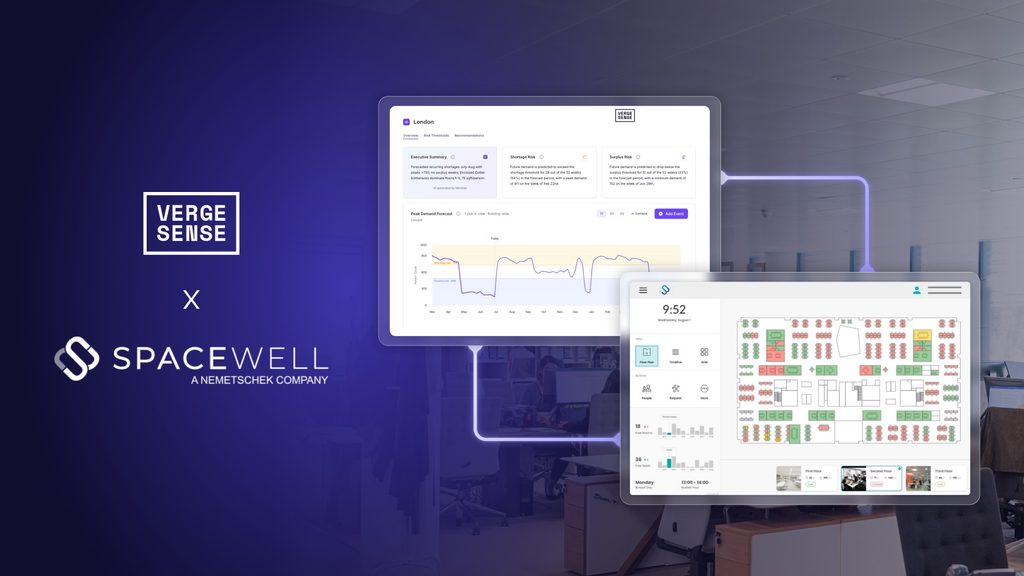
When the workplace data Spacewell already holds flows into the Meridian platform VergeSense, space planning becomes a continuous loop, modeled off your organization’s unique conditions.
Two scenarios show the shift most clearly.
Offices you already operate. Spacewell describes how the space is genuinely used. Predictive Planning forecasts what it will need next. You refit, reconfigure, or hand space back on real evidence, rather than waiting for the next lease event to force the question.
Offices you are considering. The behavioral profile of your current portfolio tests a candidate space before you sign, showing how that floor plate would land for your people instead of relying on a generic fit.
In the language finance uses, that means hours rather than months to a plan with savings, payback, and ROI attached. It replaces the study that used to cost $250K and take half a year to arrive.
The approach is proven at enterprise scale: $60M in lease costs avoided at a global healthcare company, $18M saved over three years at a global financial services firm, and $13M in expansion costs avoided at a global biotechnology company.
It is also available today. Customers can start from the portfolio and workplace data they already have, then progressively enrich the model with floor plans, occupancy intelligence, and other behavioral signals where they exist.
The effects reach across stakeholders:
- Real estate leaders right-size your portfolio on evidence of how teams actually work.
- Workplace leaders design for real behavior, then execute in the tools employees already use.
- Occupancy planners get an independent read on any move, refit, or consolidation before budget is committed, in hours rather than months, without waiting on an outside firm.
- Finance leaders get defensible numbers that stay current, not a one-time slide built on assumptions.
The direction of travel
Each of us has taken the guesswork out of one half of this problem. Spacewell runs the workplace and holds the record of how it operates. VergeSense turns behavior into a forecast of what a space will need. The interesting work ahead is the connection between them.
Ready to move beyond guesswork?
Talk to our workplace experts about using the data you already have to plan, optimize and adapt your spaces with greater confidence.