To measure indoor air quality (IAQ) in your office or building, install sensors that continuously track CO2, temperature, relative humidity, volatile organic compounds (VOCs) and particulate matter (PM2.5 and PM10). Place them in occupied rooms, and compare the readings with a recognised reference such as EN 16798-1 or your national ventilation rules. That’s the practical how-to. But the value comes from what you do with that data: adjusting ventilation, alerting maintenance teams and balancing air quality against energy use.
This article focuses summarises the parameters to measure, which thresholds apply in Europe, how to select and place sensors, and how facility and energy managers use the data in practice.
What is Indoor Air Quality and what factors influence it?
Indoor air quality describes how clean and healthy the air inside a building is for the people who use it. It depends on pollutants generated indoors (people, materials, cleaning products, equipment), pollutants coming in from outside, and how well the building is ventilated.
IAQ vs indoor environmental quality (IEQ)
IAQ is one part of a broader concept, indoor environmental quality (IEQ). The EPBD (EU) 2024/1275 defines IEQ as the result of an assessment of the conditions inside a building that influence the health and wellbeing of its occupants, based on parameters such as temperature, humidity, ventilation rate and the presence of contaminants. IEQ also covers lighting and acoustics. IAQ focuses on the air itself.
Which parameters should you measure?
Most non-residential buildings start with five core parameters. Add others depending on building use and known risks.
| Parameter | What it tells you | Typical sources |
|---|---|---|
| CO2 | How well a room is ventilated relative to the number of people | People breathing |
| Temperature | Thermal comfort, HVAC performance | HVAC, solar gain, occupancy |
| Relative humidity | Comfort, risk of mould or dry air | Climate, ventilation, occupancy |
| VOCs (often reported as TVOC) | Chemical emissions | Paints, furniture, flooring, cleaning products |
| PM2.5 and PM10 | Fine and coarse particles | Outdoor traffic, printers, cooking, construction work |
Additional parameters in specific contexts include radon (in regions with radon-prone soil), formaldehyde, carbon monoxide, noise and light levels.
Why measure Indoor Air Quality of your buildings for health and performance
On average, we spend 90% of our time inside buildings, according to the EU Commission. The quality of that air we breathe affects different elements:
User’s health and cognitive performance. Poorly ventilated rooms and high pollutant levels are linked to headaches, fatigue, irritated eyes and airways, and higher absenteeism.
Energy consumption. Balance between ventilation and energy use is not simple. It takes energy to cool or heat air indoors, but it is necessary for wellbeing. Measurement of IAQ lets you ventilate when needed, not by estimates.
What does the legislation say about air quality in public buildings?
IAQ was covered by each country’s own regulations, but the 2024 revision of the EPBD included regulation on indoor air quality to ensure “adequate indoor quality standards”.
Although the EPBD doesn’t impose IAQ measuring in all buildings, which would be difficult to track, new net-zero buildings must install meters, and existing buildings will need to install them when doing renovation.
Lastly, building automation and control systems as stated in the EPBD will be required to monitor IAQ data, besides energy.
What is a good level of CO2 in an office?
For most offices in Europe, keeping CO2 below about 1,000 to 1,200 ppm while rooms are occupied is a reasonable operational target. Below 800 ppm generally indicates good ventilation. These figures assume an outdoor level of about 400 ppm.
Three points matter when you set your own target:
- Many standards express limits as a difference above outdoor CO2, not as an absolute value. EN 16798-1 Category II (800 ppm above outdoor) works out to about 1,200 ppm in practice.
- National rules differ. Spain’s RITE (500 ppm above outdoor for offices) is stricter than Germany’s ASR A3.6 (1,000 ppm absolute).
- Look at patterns, not single readings. Sustained levels during occupied hours tell you more than a short peak at the end of a meeting.
What sensors and technology are needed to monitor IAQ?
The choice of hardware to monitor IAQ is important, as there is an increasing number of options on the market and not all of them may meet your needs. The most important thing is that the sensors in question communicate via an open protocol so that you can visualise and analyse your data on any platform, like Spacewell. Here is a list of the features that will influence your choice:
- Communication: Wired communication (Modbus, LonWorks, BACnet, etc) or wireless communication (WiFi, Sigfox, LoRa, Zigbee, etc).
- Power: Alkaline battery-powered, rechargeable battery-powered, battery-powered or electrically powered sensors.
- Display/Display: Sensors with display (users can view the parameters on the sensor itself) or sensors without display (only people with access to the display software can view the data). Some sensors may also have some qualitative indicators in the form of coloured LEDs.
- Variables to be measured: Until now, it was most common to find sensors on the market that measure temperature, humidity and CO₂. As mentioned above, other parameters are decisive in ensuring good air quality, such as particulate matter or volatile organic compounds.
Depending on the characteristics chosen for your project, the cost of the hardware and the cost of its installation can vary greatly. Most of all for the hardware, the factor that most influences its price would be the number of variables to be measured. Basically, the more variables the more expensive the sensor will be, while the factors that most influence the installation cost would be the communication protocol of the installed hardware and its power supply.
You can view data on temperature, humidity, CO₂, PM2.5, PM10 and TVOC. It is a very easy-to-use tool: you just have to select the devices you want to analyse, the data visualisation period, and if you need to, add a time filter such as the working hours of your office, and click.
Five ways to use indoor air quality data
1. Check whether rooms are ventilated well enough.
Compare CO2 readings across floors and rooms during working hours. A meeting room that regularly exceeds your threshold while others stay low points to a ventilation or occupancy problem in that space. Combining CO2 with temperature and humidity shows whether people are both safe and comfortable.
2. Alert the right people when thresholds are exceeded.
Set alerts for occupied hours only, for example Monday to Friday from 7:00 to 19:00. When a room passes the threshold, notify the facility or maintenance manager. Better still, create a work order automatically in your maintenance software, so the issue is tracked until it is fixed.
3. Balance air quality and energy consumption.
Overlay IAQ data with energy consumption and occupancy. You can then see which air handling units are most efficient, detect a unit that is losing efficiency, and spot spaces that are ventilated at full rate while empty. This is where IAQ monitoring supports energy savings instead of competing with them.
4. Troubleshoot specific problems.
Localised sensors help you find the cause of a problem. A VOC spike after new furniture or flooring is installed in a meeting room shows the room needs extra ventilation until emissions drop. Comfort complaints in a small room that overheats can be confirmed and fixed through HVAC tuning.
5. Share air quality information with occupants.
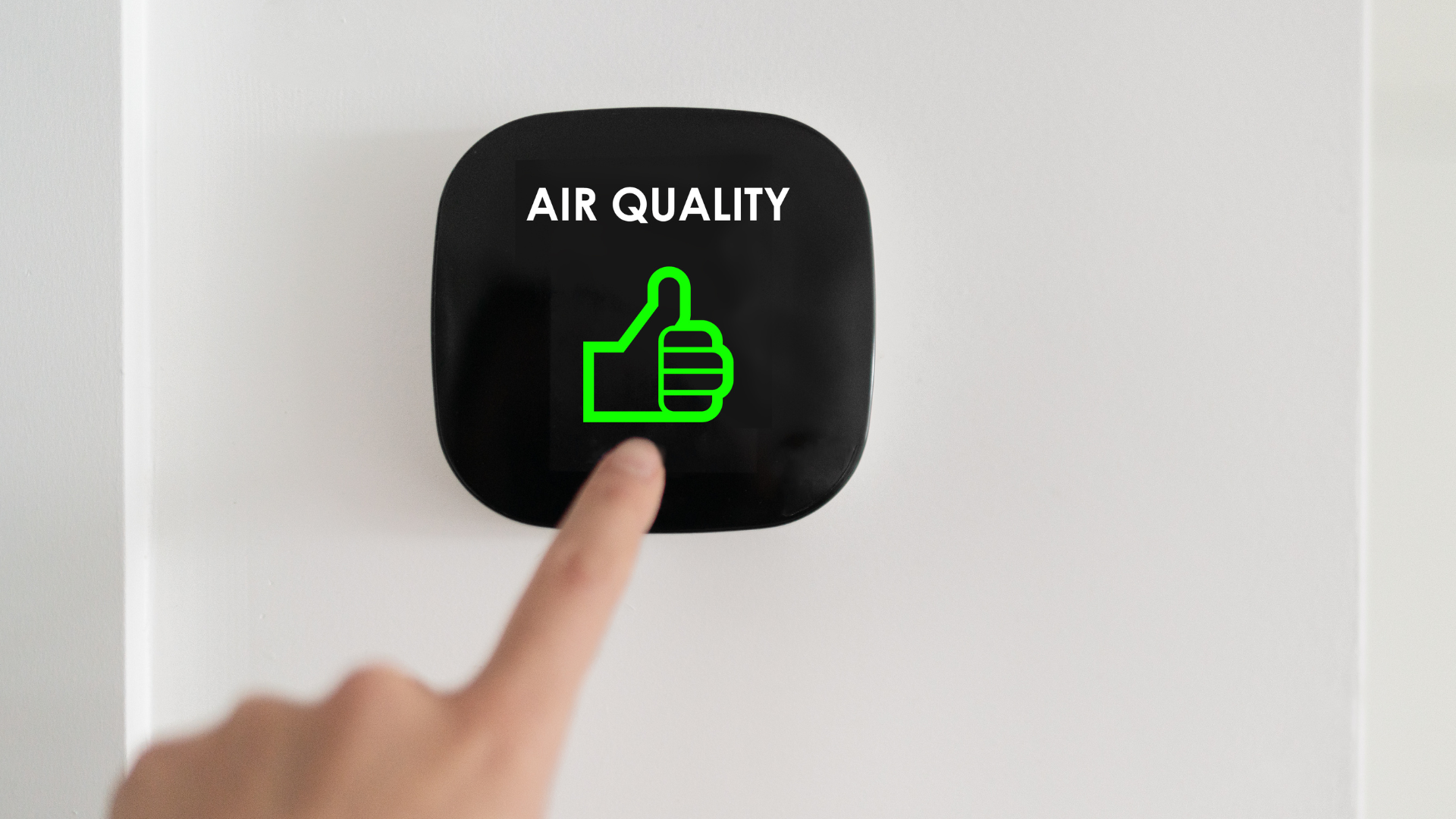
Show live conditions where people can see them: colour LEDs in meeting rooms, a screen at the entrance, or the workplace app. Transparency builds trust, and it lets people choose comfortable spaces.
Spacewell allows you to monitor and monitor IAQ across your offices and buildings. IAQ data can be included in occupancy floorplans, alerts can be set up when levels exceed the thresholds, and employees can choose which spaces to book taking IAQ levels into consideration.