
Energy prices have become a volatile strategic risk for organizations for several years now. Geopolitical decisions, tensions, and war affect them enormously and have turned energy efficiency into a strategic decision for business.
The surging prices of oil and gas turn into higher utility bills, making operational budgets harder to plan and raising questions about how efficiently office buildings are running. At the same time, office use patterns are still evolving since the introduction of hybrid work, often in ways that traditional building operations do not reflect.
Offices can be energy-intensive environments, with heating, cooling, ventilation, lighting, and IT equipment running for long hours. However, these systems are still commonly scheduled for assumed full occupancy instead of real demand. The result is that many companies are paying to heat, cool, and light space that is only partially used. In the context of volatile prices and tighter budgets, this gap is no longer acceptable.
How do energy prices affect office environments?
Rising and unpredictable energy prices affect offices on several levels. The most visible is financial: higher operating expenses, budget overruns, and pressure on facility and real estate managers to “do more with less.” For multi-site portfolios, cross-subsidizing high-cost locations becomes increasingly difficult, prompting tougher decisions about consolidation and investment.
Operationally, organizations may respond with quick fixes: lowering temperature setpoints, limiting after-hours access, or manually switching systems off earlier.
These measures may translate short-term savings, but they often come with trade‑offs in comfort and productivity. Employees may start to feel that the office is less attractive than working from home, especially in winter or during heatwaves.
There is also a strategic dimension. Energy price pressure accelerates conversations about the size and configuration of the office portfolio. Companies review whether all locations are still needed, whether floors can be closed or sublet, and how space utilization should inform future lease decisions. However, these decisions are often taken with incomplete data about how spaces are used day-to-day. Spacewell Workplace can help organizations by providing real usage data, helping management to understand whether there’s any opportunities to reduce real estate footage or plan office spaces differently.
Connecting space and energy use
Workplace and energy decisions are often made in separate departments. Real estate and workplace teams may have some data on occupancy or meeting room bookings. Energy and sustainability teams have metering and consumption information. Without connecting these two perspectives, it is hard to understand where energy is being wasted and where targeted interventions would have the biggest impact.
Hybrid work amplifies this challenge. On some days, entire zones are nearly empty. On others, certain areas are heavily used while others remain underutilized. Yet building systems frequently follow fixed schedules and static assumptions, delivering the same level of heating, cooling, and lighting regardless of actual presence. To move beyond reactive cost-cutting, organizations need to see how spaces are used and when they consume energy, in one coherent picture.

How workplace and energy data support proactive planning
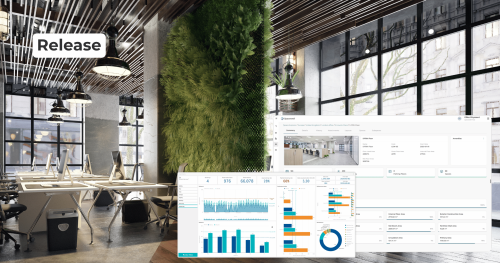
Crossing data from space utilization and occupancy data with energy consumption helps you have a clear picture of how your office space is performing.
On the workplace side, data can include sensor-based occupancy, desk and room bookings, and presence patterns by zone, floor, and building. Spacewell Workplace allows organizations to identify consistently underused areas, peak and off-peak days, and the true footprint needed to support their current way of working.
On the energy side, consumption data provides profiles across sites, systems, and time. Within Spacewell Energy, historical and near real-time data make it possible to detect anomalies, see how usage responds to temperature or tariff changes, and benchmark buildings against each other.
When these two data streams are brought together, the conversation shifts. Instead of asking “Where can we cut costs quickly?”, organizations can ask more targeted questions, such as:
- Which zones are regularly under-occupied but still fully conditioned?
- What would be the impact of closing a floor three days per week and concentrating activity elsewhere?
- How can we adjust HVAC and lighting schedules so they align with real presence, not just office hours?
- Where do investments in automation, insulation, or equipment upgrades have the highest return, given actual usage?
By combining workplace and energy data, organizations can simulate different scenarios, compare comfort and cost implications, and prepare measures before the next energy price spike hits. This is what Merck is doing in Germany, looking at space efficiency and energy efficiency together with the help of Spacewell.
From short-term reaction to long-term planning
Energy price volatility is unlikely to disappear in the near term, and to add up, pressure to reduce emissions will only grow. Organizations that rely solely on short-term, manual interventions risk constant problem-solving and employee dissatisfaction. By building a more integrated view of workplaces and energy use, you can move towards proactive optimization.
In practice, this means using insights from combined workplace and energy data to guide long-term space planning, support investment cases for retrofits or smart controls, and communicate transparently with finance, HR, and sustainability stakeholders. Spacewell solutions can help you bring these perspectives together, and support organizations move from reactive cost-cutting to planned, resilient office strategies.
Discover all the capabilities of Spacewell
Curious how data-driven workplace energy management can help you cut energy costs and optimize your office spaces? Fill in the form below and we’ll show you what’s possible with your buildings and workplaces.