
GACS compliance is becoming an urgent priority for owners and operators of large non-residential buildings in the Benelux. And the pressure goes beyond installing a control system. Many organizations are now trying to understand what else they need to make energy performance visible, measurable and easier to improve over time.
A Building Automation and Control System (BACS or GACS) can actively control systems such as HVAC and lighting. But control alone does not show where energy is being wasted, which sites are underperforming, or how progress should be tracked across a portfolio. That is why many organizations will need more than one system in place.
BACS regulations and regional context in Europe
Across Europe, BACS are becoming a regulatory requirement for larger non‑residential buildings. The recast of the EU Directive for Energy Performance of Buildings (EPBD) establishes obligations for buildings above certain heating and cooling capacity thresholds to be equipped with BACS that can monitor, log, and optimise energy performance.
In Benelux, GACS compliance has been developed from the EPBD for building owners and operators, that makes this more than a compliance story. It becomes a performance story too. Because once automation is mandatory, the next challenge is turning building data into action, insight, and measurable improvement across the portfolio.
Countries such as France or Germany have already embedded these requirements into national law, with specific deadlines for non‑residential buildings whose HVAC capacity exceeds defined kilowatt thresholds. In France, for example, the so‑called BACS decree targets tertiary buildings and sets staged deadlines for installing compliant building management and control systems; while Germany and the Netherlands have integrated BACS obligations into their building‑energy legislation. For owners of multi‑country portfolios, this creates a strong need for reliable building automation, transparent energy data, and auditable reporting across all sites.
In Southern Europe, Spain and Italy are likewise transposing the latest EPBD provisions into national frameworks, strengthening expectations around metering, monitoring, and automated control in larger buildings. While the specific legal instruments differ by country, the direction of travel is consistent: automation and digitalisation of building systems are seen as essential enablers of energy efficiency, resilience, and decarbonisation.
What GACS compliance means for building owners
On paper, building automation sounds straightforward. Install the right control capabilities. Connect technical systems. Meet the requirement. In reality, the challenge is broader.
Most organizations are not managing one building in isolation. They are dealing with multiple sites, fragmented data, different systems, and rising pressure to reduce cost and improve sustainability outcomes at the same time. In that environment, control is essential, but it is only one part of the operational picture.
That is because real estate teams need clear answers about building performance and efficiency besides control. Which buildings are drifting off target? Where is abnormal consumption appearing? Which actions will deliver the biggest savings? And how can teams show progress in a way that is consistent, auditable, and usable across an entire portfolio?
Why one system is not enough for GACS compliance
This is the key point. GACS compliance should not be seen as a single-system decision. It is better understood as a stack of capabilities.
One layer handles control. Another layer helps organizations understand energy consumption, benchmark performance, model scenarios, and generate reporting that supports decision-making and ongoing improvement. In larger portfolios, that second layer becomes especially important because manual analysis does not scale well, and fragmented data makes it difficult to prove outcomes with confidence.
That is also why the market conversation is evolving. Buyers are not only asking whether their buildings can be controlled. They are asking whether they can trust the data, identify waste faster, and turn energy information into repeatable action across sites.
How Spacewell Energy supports GACS compliance
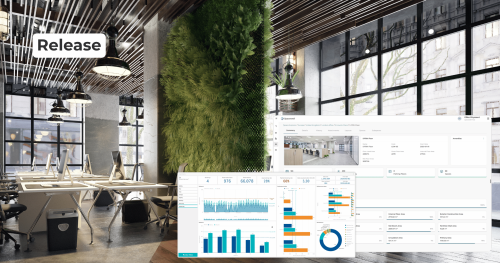
This is where Spacewell Energy has a clear role to play. It is a portfolio-scale Energy Management System designed to help organizations understand, model, and optimize how energy is consumed, produced, stored, and transformed across buildings.
Importantly, Spacewell Energy is not a GACS. It does not perform active equipment control or real-time BMS automation. Instead, it complements the control by adding portfolio-level aggregation and benchmarking, energy, cost, savings and CO2 analytics, anomaly detection, scalable dashboards and reporting templates, and integrations with meters, BMS platforms, DSOs, and IoT systems.
That makes it particularly relevant for organizations asking the next logical question after compliance: how do we monitor results, identify inefficiencies, and keep improving over time? Spacewell Energy is built to support exactly that with trusted energy intelligence, auditable outcomes, and repeatable analysis at scale.
The product messaging also points to measurable value. Spacewell Energy has delivered 5 to 20 percent energy reduction driven by visibility, benchmarking, and prioritization, along with faster anomaly detection, reduced manual reporting effort, and improved auditability of cost and CO2 data, although results vary by portfolio maturity and data quality.
Turning GACS compliance into a performance opportunity
That is why GACS compliance should not be framed only as a regulatory burden. For many building owners, it is also an opportunity to modernize how energy performance is managed across the portfolio.
Used together, BAS and an EMS form a powerful combination: the BAS executes control actions in real time at building level, while the EMS provides the strategic, data‑driven oversight needed to prioritise interventions and track results over time.
The organizations that benefit most will be the ones that treat compliance as the starting point, not the finish line. Control matters. But so do insight, evidence, and the ability to prioritize action with confidence.
In that broader picture, Spacewell Energy is not the control system itself. It is the energy intelligence layer that helps organizations turn building automation into measurable performance improvement. Find out more about Spacewell Energy’s reporting capabilities here.
Note: This article focuses on GACS compliance in Benelux, but it is also applicable to gain efficiency with BACS and Energy Management Systems in other countries and under local regulations.
Looking at this from a Nordic market perspective? Read our blog: How Nordic building owners can prepare for stricter energy rules.