
Talk to almost any facilities or operations leader, and the same frustrations come up again and again.
Too many processes still rely on paper, emails, or scattered Excel files. Systems that were meant to bring structure often end up being avoided by the very people who should use them. And instead of simplifying operations, they create friction.
This is not just a maintenance problem. It is a broader facility management challenge.
From service requests to asset maintenance, from supplier coordination to compliance, many organizations are still stitching together workflows across disconnected tools. The result is inefficiency, lack of visibility, and missed opportunities to improve service quality.
Where Traditional CMMS and CAFM Tools Fall Short
Legacy CMMS and CAFM solutions were often designed with control and administration in mind, not usability.
Technicians and facility teams frequently experience these systems as complex and time-consuming. As a result, adoption suffers. Work gets tracked outside the system, data becomes unreliable, and the platform loses its value.
Another recurring issue is integration. Many solutions operate in isolation, making it difficult to connect facility operations with procurement, HR, IoT platforms, or financial systems. This limits automation and prevents organizations from gaining a complete view of their operations.
Finally, these tools are often rigid. They assume a fixed way of working, while in reality, every organization has its own processes, maturity level, and pace of digital transformation.
Moving Beyond CMMS: A Unified Approach with Spacewell Asset
This is where a broader approach to facility management comes in.
Spacewell Asset is not just a CMMS. It is a comprehensive CAFM platform that connects maintenance, facility services, and supplier management into one cohesive environment.
At its core, it covers all essential capabilities:
Service Request Management
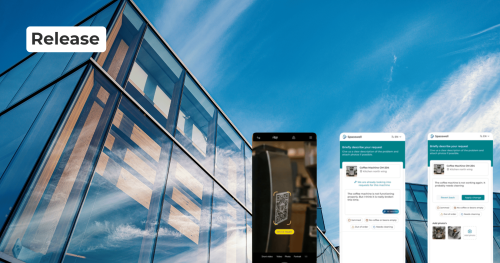
Employees, tenants, or customers can easily submit requests through intuitive interfaces. These service requests are automatically routed, prioritized, and tracked, ensuring nothing falls through the cracks.
Work Order Management
Facility teams can plan, assign, and monitor tasks across sites with full visibility. Workflows are configurable, allowing organizations to match the system to their way of working.
Preventive and long-term Maintenance
Recurring maintenance scheduling, combined with NEN2767 condition assessments, provides clear asset insights and supports structured long-term maintenance planning.
Asset Lifecycle Management
Every asset has a complete digital record, including maintenance history, documentation, performance data, and current status. This creates a strong foundation for better decision-making and long-term planning.
Supplier and Contract Management
External partners play a crucial role in facility operations. Spacewell Asset centralizes supplier information, contracts, SLAs, and performance tracking, enabling better control and collaboration.
Inventory and Spare Parts Management
Stock levels, part usage, and availability are managed across locations, reducing delays and avoiding unnecessary downtime.
Compliance and Safety
Procedures, inspections, and checklists are digitized to ensure consistent execution and regulatory compliance.
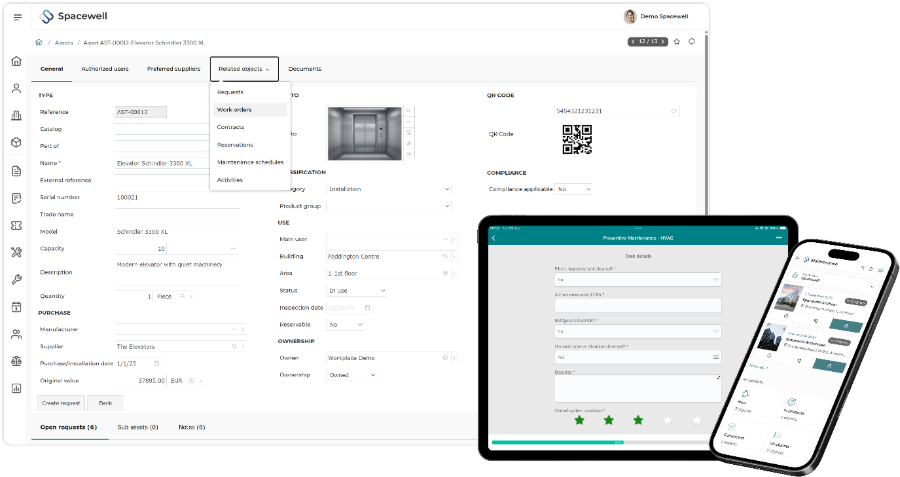
Figure 1 – Spacewell Asset applications
What Makes the Difference in Practice
The real impact of a CAFM platform is not defined by its feature list, but by how it is used day to day.
1. Built for the People Doing the Work
Adoption starts with usability. Spacewell Asset is designed with a user-first mindset, offering intuitive mobile and web experiences that make it easy for technicians, facility managers, and end users to interact with the system.
2. Connected to the Broader Ecosystem
Facility management does not operate in isolation. Spacewell connects with IoT platforms, Workplace and Energy solutions, and external enterprise systems, enabling automation and real-time insights across domains.
3. Flexible and Scalable
Organizations can start where they are, whether that means replacing spreadsheets or optimizing complex multi-site operations. The platform adapts to different processes and maturity levels, without forcing a one-size-fits-all approach.
4. From Operations to Insights
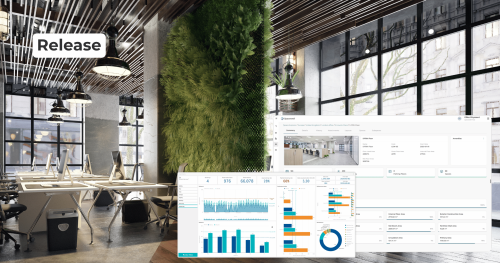
By centralizing data across services, assets, and suppliers, Spacewell Asset enables organizations to move from reactive operations to data-driven decision-making.
5. AI as the Next Productivity Layer
The next step in facility management is not just digitization, but augmentation. Spacewell is actively embedding AI capabilities that assist key users in real time.
Imagine receiving a work order and instantly getting a clear summary of the asset history, past interventions, known issues, and relevant supplier contracts. Instead of digging through multiple screens and documents, AI surfaces the context and even suggests the most appropriate next actions.
This dramatically reduces the time spent understanding situations, coordinating with suppliers, and making decisions. It allows teams to act faster, with more confidence, and at a level of productivity that simply was not achievable before.
“Facility management is moving from reactive execution to intelligent orchestration. The real value comes when systems not only capture data, but actively guide users toward the right decisions. That is where we see the future of Spacewell Asset.” Gilles Ghyssaert, Chief Product Officer at Spacewell
From Fragmentation to Control
Facility management is becoming more complex, not less. Expectations around service quality, efficiency, and sustainability continue to rise.
To meet these demands, organizations need more than just a CMMS. They need a platform that connects all aspects of facility operations.
Spacewell Asset provides that foundation. Not by adding more complexity, but by simplifying workflows, improving adoption, and bringing everything together in one place.
Because in the end, the goal is not just to manage buildings and assets better. It is to deliver better experiences, reduce costs, and create environments that truly support the people who use them.