
The energy transition, supported by growing public awareness of climate change has led to the emergence of energy communities around the world.
What are Energy Communities and how can you benefit from them?
Based on individual self-consumption, these communities have been formed to generate and benefit from the electricity generated locally by collaborating with companies, local councils and neighbours. This demonstrates that an increasing number of consumers wants to be active and responsible and thus, are becoming “prosumers” (producers and consumers) of energy.
In this article, you will find out what an energy community is, how this model is evolving in the UK and how it can benefit from the use of an EMS.
The first energy communities were built before a name or a specific regulation was established for them. To regularise and encourage their implementation, the European Union has implemented a regulation defining two concepts: the Citizen Energy Community (Directive (EU) 2019/944) and the Renewable Energy Community (Directive (EU) 2018/2001).
Like other entities, energy communities need governance and regulatory arrangements as they face higher investment risks compared to commercial energy providers. Therefore, the UK government decided that they would benefit from tax-advantaged investment under the SITR (Social Investment Tax Relief).
Before you keep reading, it is important to clarify that energy communities are not competitors of energy providers. They are just another player in the energy market with a local and non-commercial vision. In fact, in many cases, they continue to collaborate with them and with energy services companies to initiate or manage projects. In this article, you can find out more about the role of utilities in self-consumption in the UK.
Key Elements of an Energy Community
Energy communities can vary in their set up, and their definition varies slightly between countries. This makes it difficult to find a single definition or a total number of these communities. But still, there are a number of characteristics for a collective self-consumption project to be considered as an Energy Community.
These are:
- Generation of Renewable energy. The type of energy produced and consumed in these communities is, by definition, renewable. The project may include electrification, installation of solar panels, district heating networks, heat pumps, biomass or hydroelectric production.
- Local approach. These are local projects, with buildings and installations within a radius of 500m, typically.
- Legal entity. An energy community is not just a group of consumers, it requires a legal entity to be constituted.
- Voluntary participation. No company or neighbour in the vicinity should be forced to participate. In general, these projects seek consensus and community building. Therefore, they are attractive to many but are not compulsory.
- Collaboration and diversity of participants. Members of communities can be both individuals and legal entities. They can include residential and local administrations, as well as offices, factories or sports facilities. For instance, a residential development that collaborates with a school and an office block, a municipality that cooperates with agriculture, or even a hotel working with its neighbours.
- Search for energy and costs savings without profit. Economic saving is a clear objective along with sustainability, but these communities are not aiming at generating money. Although they can “sell” unused energy to the main grid, this will have an impact on the bills with discounted prices for the community.
Therefore, energy communities create small energy grids (microgrids), independent from the main ones. As seen above, their aim is to benefit local actors by controlling their production, reducing their consumption, making them more efficient and creating community.
In the context of energy communities, an energy management system is extremely useful to analyse the consumption of existing installations, make predictions of your energy production and consumption and also monitor the change once solar panels or other energy generation is installed.
How are Energy Communities Financed?
The long-term goal is to generate savings, but before this can be achieved, an initial investment is required to install panels, windmills, meters, etc. This first investment can be covered by public subsidies, by companies, energy services companies or neighbours.
In the UK, there are many funding options that fall under six main categories: Grant Funding, Location-based Grant Funding, Council Climate Funds, Grant Funding Organisations, Crowdfunding and Coronavirus Emergency Funding. These fundings cover various aspects of the energy community such as initial advice, installation of panels and meters, energy generation, energy storage, energy efficiency and mobility.
Energy Communities in the UK and Europe
The Community Energy State of the Sector in 2026 identifies over 600 organisations across the UK, with an installed capacity of a total of more than 400 MW, of which solar represents almost 70%. Economic benefits included £1.86 million in energy bills savings. Within Europe, there are over 8000 of these communities, and the number continues to grow, supported by funding such as the Next Generation or the LIFE funds.
The origin of energy in these communities is diverse, but solar photovoltaic is predominant in all countries. The UK has great potential with solar energy but still has significant room for improvement compared to other countries such as the Netherlands, Denmark and Germany. And even those countries, which relied more on wind energy in the past, are seeing solar photovoltaic grow as well.
These figures show how self-consumption of energy continues to grow, not only in the residential sector but across all types of facilities and users. And how the figure of energy communities is key to the local development of renewable energy.
Some of the best known and pioneering examples of energy communities in the UK are:
Baywind Cooperative is considered to be the first energy community in the UK, formed in 1996. Its funds were raised directly from members of the general public, which enabled them to invest in local wind turbines in Cumbria.
Eigg Electric describe themselves as a “community-owned, managed and maintained company which provides electricity for all island residents from the renewable sources of water, sun, and wind.” Thanks to the coordinated efforts of its inhabitants, the Scottish island of Eigg is self-sufficient in terms of energy needs.
Edinburgh Community Solar Cooperative
Edinburgh Community Solar Cooperative generates 1.1GWh of electricity each year. profits are invested in various projects throughout the city of Edinburgh, in order to promote renewable energy.
Community Energy Scotland offers technical support for community project development in green energy and energy conservation. It is an independent organisation whose mission is to build a more democratic energy system.
Leominster Community Solar generated electricity for a community building in the city. By doing so, they offer local people the opportunity to invest in renewable, clean and green energy. To realise this project, LCS raised £150,725 from 94 locals.
BWCE is a non-profit community benefit organisation founded in 2010. So far, they have installed 12.35MW of renewable energy, powering about 4’000 homes. BWCE have raised about £20 million to build their projects.
Energy Efficiency in Energy Communities
Participation at a local level in an energy community makes the members aware of and involved in energy efficiency and energy savings. It is a matter of sustainability and cost saving, but also one for community building and decentralisation.
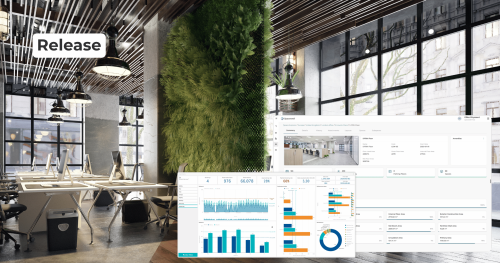
When it comes to management of day-to-day operations, some communities outsource management to a consultancy or marketing company. In this situation, the management company can use the Spacewell Energy to monitor, evaluate results and identify areas for growth.
In addition, you can also use the tool to share information with community members, produce individualised reports for each building or location (shops, offices, flats, etc.), and process invoices. In this case, each company, shop, municipality or neighbour of the community can have access accounts to the platform to track and compare data.