
Client
Hospital de la Santa Creu i Sant Pau Private Foundation
Scope
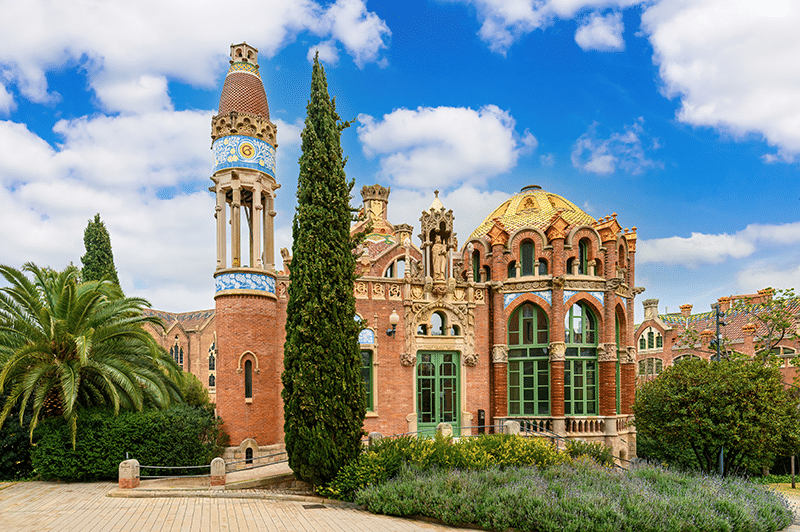
15 buildings of the Santa Creu i Sant Pau Art Nouveau Site, one of the largest modernist complexes in the world and a UNESCO World Heritage Site.
Sustainable Refurbishment of a Heritage Site
The Art Nouveau complex that houses the Hospital de la Santa Creu i Sant Pau was restored between 2010 and 2014. In addition to recovering the original artistic and architectural elements, steps were also taken to adapt the space and infrastructure to make it fit for the future, including innovative measures to reduce energy costs.
During the restoration, more than 140 utility meters (electricity, thermal mass flow, water) were installed in the different pavilions. After the renovation, it soon became clear that it was not easy to manage and gain insight into all this energy data. The problem was that there was no truly analytical tool available to keep track of the evolution of the numerous and detailed consumptions of all the buildings.
Energy monitoring to reduce consumption
With an annual consumption of 2,307,705 kWh, the main objective was to optimize the buildings’ energy consumption. The main problems for the Foundation were:
- to determine where it could reduce or eliminate unnecessary or wasteful energy consumption
- to detect differences between buildings with similar activities and surface areas
- to reduce manual management of the 140 meters that took a lot of time and resources and did not provide the right analysis and visualization tools and compare readings
How Spacewell Energy helped improve energy efficiency in these historic buildings
Spacewell Energy turned out to be the key to success as it enables the Foundation to collect accurate energy data in real-time and to visualize and analyze it easily. It saves time and eliminates manual errors in meter readings, and it provides up-to-the-minute data with pinpoint accuracy.
A significant amount of work was done to pull the data from 140 meters of various brands and models. Once the appropriate parameters and conversion factors were accurately configured, the platform detected discrepancies in performance between areas that should be operating similarly.
As a result of the energy efficiency project, protocols or schedules have been modified and the behavior of buildings has been homogenized.
The solution has also been useful to:
- detect excessive consumption at times or in spaces that should have been on standby
- track historical consumption data to compare and improve the energy efficiency in the site’s historic buildings
- identify and repair several installations with faults or leaks
Historic buildings and improving energy efficiency: the potential is clear
All of this led to an immediate and tangible reduction in energy consumption and to financial savings of €76,000 in just the first half of the year, equivalent to a decrease of 28% in energy costs compared to the previous year. The analysis of energy performance made it possible to reduce expenses in non-essential areas, optimize consumption at night and on weekends, and turn off equipment whose operation was unnecessary.
I believe that the Spacewell Energy (Dexma) platform more than meets the objectives and results expected for this type of application. It is simple to operate and very intuitive, while also offering a very understandable and fast visualization of the data.
Agustí Grau i Franquesaevic
Engineering and Works Director